
Park Service issues annual resource, law enforcement reports
The National Park Service has issued its annual reports on protected species and law enforcement.
The reports, posted on the NPS park planning website detail how threatened and endangered species –piping plovers, sea turtles, and seabeach amaranth – fared this year on the Cape Hatteras National Seashore. Also included are reports on two other protected species, colonial waterbirds and the American oystercatcher. The law enforcement report details violations at the seashore last year.
Many, if not most, of the details in the reports were made public last year in the seashore’s weekly resource management reports and in other news stories.
Here’s a quick summary of each.
PIPING PLOVERS
“The 2011 breeding season was not as successful in terms of productivity as the 2010 season but was still considered a good year,” the reports says.
Fifteen breeding pairs of piping plovers were identified through field observations, matching the previous high of 15 pairs documented in 1989. The seashore appears to have recovered from the sharp decline in pair numbers that started in 1996 and continues to exhibit an upward trend in breeding pairs, the report says.
In 2011, nesting occurred at five sites: Bodie Island Spit, Cape Point, South Beach, North Ocracoke Spit, and South Point. After a two-year absence from the area, two pairs nested on Bodie Island Spit. Five pairs were documented at Cape Point and two pairs were documented on South Beach. This was the second year in a row that a pair nested on
North Ocracoke Spit, and the five pairs identified on South Point at Ocracoke were the most ever recorded for that area.
The 15 pairs produced 18 known nests and 12 broods, of which only 10 chicks fledged – one on Bodie Island spit, one on South Point on Ocracoke, and seven on Cape Point.
Once again, the weather was ideal during the nesting season, and most of the chicks were lost to known or presumed predation.
Most violations of resource closures were by pedestrians.
SEA TURTLES
In 2011, 147 sea turtle nests were documented at Cape Hatteras National Seashore, the report says, just short of the record 153 nests during 2010.
The first recorded nesting activity for the 2011 season occurred on Hatteras Island with a
loggerhead nest on May 15. The last recorded nest of the season was laid on Hatteras Island on Aug. 21. A total of 278 activities were documented of which 147 were confirmed nests and 131 were false crawls. The 147 nests on the seashore included 137 loggerhead nests, nine green nests, and one Kemp’s ridley nest.
The seashore produced 15.2 percent of the state’s turtle nests last year, down from 17.4 percent in 2010. Also, last year, there were more turtle nests than usual on all of the North Carolina coast and many other parts of the southeast coast.
Sea turtle nesting was affected by several storms late last summer, beginning with Hurricane Irene on Aug. 27. A total of 32 nests were washed out entirely or could not be found after the storm, and an additional 12 nests saw a severe decrease in nest success (little or no hatching success).
Predation was a major factor in sea turtle nesting, and most violations of resource closures was by pedestrians.
The report also notes:
“Many visitors at CAHA, especially in front of the villages, left their recreational beach equipment and chairs or loungers on the beach overnight. This equipment and furniture can cause turtles to forgo laying eggs by hampering or trapping animals attempting to locate a nesting site. This is the tenth season that Resource Management staff has tied notices to personal property found on the beach after dawn, advising owners of the threats to nesting sea turtles as well as safety issues and NPS regulations regarding abandoned property. The date and time items were tagged was clearly written on each tag. Items left on the beach 24 hours after tagging were removed by NPS staff. Not all tagged items were removed within 24 hours as staff patrolling on UTVs could not safely remove the property from the beach.”
“At other times, not all abandoned property could be removed because of the abundance encountered and staff availability. In 2011, two incidents of nesting sea turtles being impacted by beach equipment being left on the beach overnight.”
SEABEACH AMARANTH
Seabeach amaranth was listed as federally threatened in 1993. At the time of its listing, the species had been eliminated from two-thirds of its historic range that extended from Massachusetts to South Carolina. It’s an annual plant that is found on overwash flats at accreting ends of barrier islands and along lower foredunes.
“The life history of seabeach amaranth as a pioneer species accounts for the variability in plant numbers and locations of populations through time,” the annual report says. “Distribution by wind and water of seed sources into appropriate habitats is somewhat random by nature. The plants intolerance for competition by other plants limits it to areas marginally conducive to plant growth. Additionally, overwash is known to affect the plants’ ability to grow. The dynamic nature of coastal islands creates and eliminates potential habitat quickly.”
Seabeach amaranth populations have fluctuated greatly at the seashore since surveys began in 1985. In the last 10 years, numbers were the highest in 2002 with 93 plants. More recently numbers have declined with only one plant found in 2004 and two plants found in 2005. No plants have been found since 2006 and the plant is currently thought to possibly be extirpated from Cape Hatteras.
The National Park Service has issued its annual reports on protected species and law enforcement.
The reports, posted on the NPS park planning website detail how threatened and endangered species –piping plovers, sea turtles, and seabeach amaranth – fared this year on the Cape Hatteras National Seashore. Also included are reports on two other protected species, colonial waterbirds and the American oystercatcher. The law enforcement report details violations at the seashore last year.
Many, if not most, of the details in the reports were made public last year in the seashore’s weekly resource management reports and in other news stories.
Here’s a quick summary of each.
PIPING PLOVERS
“The 2011 breeding season was not as successful in terms of productivity as the 2010 season but was still considered a good year,” the reports says.
Fifteen breeding pairs of piping plovers were identified through field observations, matching the previous high of 15 pairs documented in 1989. The seashore appears to have recovered from the sharp decline in pair numbers that started in 1996 and continues to exhibit an upward trend in breeding pairs, the report says.
In 2011, nesting occurred at five sites: Bodie Island Spit, Cape Point, South Beach, North Ocracoke Spit, and South Point. After a two-year absence from the area, two pairs nested on Bodie Island Spit. Five pairs were documented at Cape Point and two pairs were documented on South Beach. This was the second year in a row that a pair nested on
North Ocracoke Spit, and the five pairs identified on South Point at Ocracoke were the most ever recorded for that area.
The 15 pairs produced 18 known nests and 12 broods, of which only 10 chicks fledged – one on Bodie Island spit, one on South Point on Ocracoke, and seven on Cape Point.
Once again, the weather was ideal during the nesting season, and most of the chicks were lost to known or presumed predation.
Most violations of resource closures were by pedestrians.
SEA TURTLES
In 2011, 147 sea turtle nests were documented at Cape Hatteras National Seashore, the report says, just short of the record 153 nests during 2010.
The first recorded nesting activity for the 2011 season occurred on Hatteras Island with a
loggerhead nest on May 15. The last recorded nest of the season was laid on Hatteras Island on Aug. 21. A total of 278 activities were documented of which 147 were confirmed nests and 131 were false crawls. The 147 nests on the seashore included 137 loggerhead nests, nine green nests, and one Kemp’s ridley nest.
The seashore produced 15.2 percent of the state’s turtle nests last year, down from 17.4 percent in 2010. Also, last year, there were more turtle nests than usual on all of the North Carolina coast and many other parts of the southeast coast.
Sea turtle nesting was affected by several storms late last summer, beginning with Hurricane Irene on Aug. 27. A total of 32 nests were washed out entirely or could not be found after the storm, and an additional 12 nests saw a severe decrease in nest success (little or no hatching success).
Predation was a major factor in sea turtle nesting, and most violations of resource closures was by pedestrians.
The report also notes:
“Many visitors at CAHA, especially in front of the villages, left their recreational beach equipment and chairs or loungers on the beach overnight. This equipment and furniture can cause turtles to forgo laying eggs by hampering or trapping animals attempting to locate a nesting site. This is the tenth season that Resource Management staff has tied notices to personal property found on the beach after dawn, advising owners of the threats to nesting sea turtles as well as safety issues and NPS regulations regarding abandoned property. The date and time items were tagged was clearly written on each tag. Items left on the beach 24 hours after tagging were removed by NPS staff. Not all tagged items were removed within 24 hours as staff patrolling on UTVs could not safely remove the property from the beach.”
“At other times, not all abandoned property could be removed because of the abundance encountered and staff availability. In 2011, two incidents of nesting sea turtles being impacted by beach equipment being left on the beach overnight.”
SEABEACH AMARANTH
Seabeach amaranth was listed as federally threatened in 1993. At the time of its listing, the species had been eliminated from two-thirds of its historic range that extended from Massachusetts to South Carolina. It’s an annual plant that is found on overwash flats at accreting ends of barrier islands and along lower foredunes.
“The life history of seabeach amaranth as a pioneer species accounts for the variability in plant numbers and locations of populations through time,” the annual report says. “Distribution by wind and water of seed sources into appropriate habitats is somewhat random by nature. The plants intolerance for competition by other plants limits it to areas marginally conducive to plant growth. Additionally, overwash is known to affect the plants’ ability to grow. The dynamic nature of coastal islands creates and eliminates potential habitat quickly.”
Seabeach amaranth populations have fluctuated greatly at the seashore since surveys began in 1985. In the last 10 years, numbers were the highest in 2002 with 93 plants. More recently numbers have declined with only one plant found in 2004 and two plants found in 2005. No plants have been found since 2006 and the plant is currently thought to possibly be extirpated from Cape Hatteras.
The National Park Service has issued its annual reports on protected species and law enforcement.
The reports, posted on the NPS park planning website detail how threatened and endangered species –piping plovers, sea turtles, and seabeach amaranth – fared this year on the Cape Hatteras National Seashore. Also included are reports on two other protected species, colonial waterbirds and the American oystercatcher. The law enforcement report details violations at the seashore last year.
Many, if not most, of the details in the reports were made public last year in the seashore’s weekly resource management reports and in other news stories.
Here’s a quick summary of each.
PIPING PLOVERS
“The 2011 breeding season was not as successful in terms of productivity as the 2010 season but was still considered a good year,” the reports says.
Fifteen breeding pairs of piping plovers were identified through field observations, matching the previous high of 15 pairs documented in 1989. The seashore appears to have recovered from the sharp decline in pair numbers that started in 1996 and continues to exhibit an upward trend in breeding pairs, the report says.
In 2011, nesting occurred at five sites: Bodie Island Spit, Cape Point, South Beach, North Ocracoke Spit, and South Point. After a two-year absence from the area, two pairs nested on Bodie Island Spit. Five pairs were documented at Cape Point and two pairs were documented on South Beach. This was the second year in a row that a pair nested on
North Ocracoke Spit, and the five pairs identified on South Point at Ocracoke were the most ever recorded for that area.
The 15 pairs produced 18 known nests and 12 broods, of which only 10 chicks fledged – one on Bodie Island spit, one on South Point on Ocracoke, and seven on Cape Point.
Once again, the weather was ideal during the nesting season, and most of the chicks were lost to known or presumed predation.
Most violations of resource closures were by pedestrians.
SEA TURTLES
In 2011, 147 sea turtle nests were documented at Cape Hatteras National Seashore, the report says, just short of the record 153 nests during 2010.
The first recorded nesting activity for the 2011 season occurred on Hatteras Island with a
loggerhead nest on May 15. The last recorded nest of the season was laid on Hatteras Island on Aug. 21. A total of 278 activities were documented of which 147 were confirmed nests and 131 were false crawls. The 147 nests on the seashore included 137 loggerhead nests, nine green nests, and one Kemp’s ridley nest.
The seashore produced 15.2 percent of the state’s turtle nests last year, down from 17.4 percent in 2010. Also, last year, there were more turtle nests than usual on all of the North Carolina coast and many other parts of the southeast coast.
Sea turtle nesting was affected by several storms late last summer, beginning with Hurricane Irene on Aug. 27. A total of 32 nests were washed out entirely or could not be found after the storm, and an additional 12 nests saw a severe decrease in nest success (little or no hatching success).
Predation was a major factor in sea turtle nesting, and most violations of resource closures was by pedestrians.
The report also notes:
“Many visitors at CAHA, especially in front of the villages, left their recreational beach equipment and chairs or loungers on the beach overnight. This equipment and furniture can cause turtles to forgo laying eggs by hampering or trapping animals attempting to locate a nesting site. This is the tenth season that Resource Management staff has tied notices to personal property found on the beach after dawn, advising owners of the threats to nesting sea turtles as well as safety issues and NPS regulations regarding abandoned property. The date and time items were tagged was clearly written on each tag. Items left on the beach 24 hours after tagging were removed by NPS staff. Not all tagged items were removed within 24 hours as staff patrolling on UTVs could not safely remove the property from the beach.”
“At other times, not all abandoned property could be removed because of the abundance encountered and staff availability. In 2011, two incidents of nesting sea turtles being impacted by beach equipment being left on the beach overnight.”
SEABEACH AMARANTH
Seabeach amaranth was listed as federally threatened in 1993. At the time of its listing, the species had been eliminated from two-thirds of its historic range that extended from Massachusetts to South Carolina. It’s an annual plant that is found on overwash flats at accreting ends of barrier islands and along lower foredunes.
“The life history of seabeach amaranth as a pioneer species accounts for the variability in plant numbers and locations of populations through time,” the annual report says. “Distribution by wind and water of seed sources into appropriate habitats is somewhat random by nature. The plants intolerance for competition by other plants limits it to areas marginally conducive to plant growth. Additionally, overwash is known to affect the plants’ ability to grow. The dynamic nature of coastal islands creates and eliminates potential habitat quickly.”
Seabeach amaranth populations have fluctuated greatly at the seashore since surveys began in 1985. In the last 10 years, numbers were the highest in 2002 with 93 plants. More recently numbers have declined with only one plant found in 2004 and two plants found in 2005. No plants have been found since 2006 and the plant is currently thought to possibly be extirpated from Cape Hatteras.
The National Park Service has issued its annual reports on protected species and law enforcement.
The reports, posted on the NPS park planning website detail how threatened and endangered species –piping plovers, sea turtles, and seabeach amaranth – fared this year on the Cape Hatteras National Seashore. Also included are reports on two other protected species, colonial waterbirds and the American oystercatcher. The law enforcement report details violations at the seashore last year.
Many, if not most, of the details in the reports were made public last year in the seashore’s weekly resource management reports and in other news stories.
Here’s a quick summary of each.
PIPING PLOVERS
“The 2011 breeding season was not as successful in terms of productivity as the 2010 season but was still considered a good year,” the reports says.
Fifteen breeding pairs of piping plovers were identified through field observations, matching the previous high of 15 pairs documented in 1989. The seashore appears to have recovered from the sharp decline in pair numbers that started in 1996 and continues to exhibit an upward trend in breeding pairs, the report says.
In 2011, nesting occurred at five sites: Bodie Island Spit, Cape Point, South Beach, North Ocracoke Spit, and South Point. After a two-year absence from the area, two pairs nested on Bodie Island Spit. Five pairs were documented at Cape Point and two pairs were documented on South Beach. This was the second year in a row that a pair nested on
North Ocracoke Spit, and the five pairs identified on South Point at Ocracoke were the most ever recorded for that area.
The 15 pairs produced 18 known nests and 12 broods, of which only 10 chicks fledged – one on Bodie Island spit, one on South Point on Ocracoke, and seven on Cape Point.
Once again, the weather was ideal during the nesting season, and most of the chicks were lost to known or presumed predation.
Most violations of resource closures were by pedestrians.
SEA TURTLES
In 2011, 147 sea turtle nests were documented at Cape Hatteras National Seashore, the report says, just short of the record 153 nests during 2010.
The first recorded nesting activity for the 2011 season occurred on Hatteras Island with a
loggerhead nest on May 15. The last recorded nest of the season was laid on Hatteras Island on Aug. 21. A total of 278 activities were documented of which 147 were confirmed nests and 131 were false crawls. The 147 nests on the seashore included 137 loggerhead nests, nine green nests, and one Kemp’s ridley nest.
The seashore produced 15.2 percent of the state’s turtle nests last year, down from 17.4 percent in 2010. Also, last year, there were more turtle nests than usual on all of the North Carolina coast and many other parts of the southeast coast.
Sea turtle nesting was affected by several storms late last summer, beginning with Hurricane Irene on Aug. 27. A total of 32 nests were washed out entirely or could not be found after the storm, and an additional 12 nests saw a severe decrease in nest success (little or no hatching success).
Predation was a major factor in sea turtle nesting, and most violations of resource closures was by pedestrians.
The report also notes:
“Many visitors at CAHA, especially in front of the villages, left their recreational beach equipment and chairs or loungers on the beach overnight. This equipment and furniture can cause turtles to forgo laying eggs by hampering or trapping animals attempting to locate a nesting site. This is the tenth season that Resource Management staff has tied notices to personal property found on the beach after dawn, advising owners of the threats to nesting sea turtles as well as safety issues and NPS regulations regarding abandoned property. The date and time items were tagged was clearly written on each tag. Items left on the beach 24 hours after tagging were removed by NPS staff. Not all tagged items were removed within 24 hours as staff patrolling on UTVs could not safely remove the property from the beach.”
“At other times, not all abandoned property could be removed because of the abundance encountered and staff availability. In 2011, two incidents of nesting sea turtles being impacted by beach equipment being left on the beach overnight.”
SEABEACH AMARANTH
Seabeach amaranth was listed as federally threatened in 1993. At the time of its listing, the species had been eliminated from two-thirds of its historic range that extended from Massachusetts to South Carolina. It’s an annual plant that is found on overwash flats at accreting ends of barrier islands and along lower foredunes.
“The life history of seabeach amaranth as a pioneer species accounts for the variability in plant numbers and locations of populations through time,” the annual report says. “Distribution by wind and water of seed sources into appropriate habitats is somewhat random by nature. The plants intolerance for competition by other plants limits it to areas marginally conducive to plant growth. Additionally, overwash is known to affect the plants’ ability to grow. The dynamic nature of coastal islands creates and eliminates potential habitat quickly.”
Seabeach amaranth populations have fluctuated greatly at the seashore since surveys began in 1985. In the last 10 years, numbers were the highest in 2002 with 93 plants. More recently numbers have declined with only one plant found in 2004 and two plants found in 2005. No plants have been found since 2006 and the plant is currently thought to possibly be extirpated from Cape Hatteras.
COLONIAL WATERBIRDS
Colonial waterbirds are those species of birds that nest in large groups or colonies and obtain their food from the water. Terns, gulls, pelicans, skimmers, and cormorants are all examples of CWB.
Last year on the seashore, there were 1,063 least tern nests, 112 common tern nests, 99 black skimmer nests, and 15 gull-billed tern nests.
The report notes that last year’s increase in nests represented the highest nest total in the past five years.
“A number of factors may have contributed to this,” the report says.
First, it notes, based on the last state-wide survey in 2007, the least tern population is increasing in the state and it is a safe assumption that Cape Hatteras is the beneficiary of immigrants from other colonies in the state. Second, timely installation of closures and increased buffers may have had an influence on the number of least tern, or other colonial waterbird pairs. Third, weather events may influence when and where the birds nest in any given year. This year we again experienced no major storms during the nesting season.
AMERICAN OYSTERCATCHERS
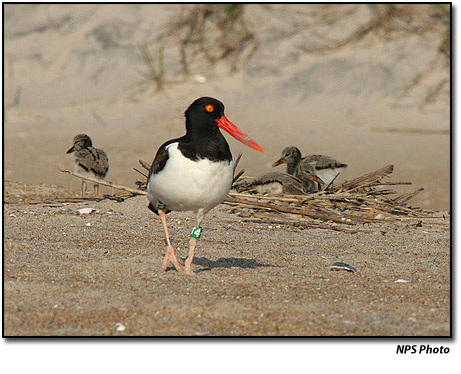
In 2011, the report says, 23 pairs of American oystercatchers nested at Cape Hatteras National Seashore. Nests, including re-nests by pairs with failed attempts, totaled 26. Of these nests, 22 (85 percent) hatched and produced chicks, for a total of 49 chicks. Seventeen pairs of the bird were successful in fledging chicks (74 percent), the most successful number of pairs since record keeping began at CAHA. There were 28 oystercatcher chicks, which represents a 1.2 fledge rate per pair, the second highest fledge rate on record.
COLONIAL WATERBIRDS
Colonial waterbirds are those species of birds that nest in large groups or colonies and obtain their food from the water. Terns, gulls, pelicans, skimmers, and cormorants are all examples of CWB.
Last year on the seashore, there were 1,063 least tern nests, 112 common tern nests, 99 black skimmer nests, and 15 gull-billed tern nests.
The report notes that last year’s increase in nests represented the highest nest total in the past five years.
“A number of factors may have contributed to this,” the report says.
First, it notes, based on the last state-wide survey in 2007, the least tern population is increasing in the state and it is a safe assumption that Cape Hatteras is the beneficiary of immigrants from other colonies in the state. Second, timely installation of closures and increased buffers may have had an influence on the number of least tern, or other colonial waterbird pairs. Third, weather events may influence when and where the birds nest in any given year. This year we again experienced no major storms during the nesting season.
AMERICAN OYSTERCATCHERS
In 2011, the report says, 23 pairs of American oystercatchers nested at Cape Hatteras National Seashore. Nests, including re-nests by pairs with failed attempts, totaled 26. Of these nests, 22 (85 percent) hatched and produced chicks, for a total of 49 chicks. Seventeen pairs of the bird were successful in fledging chicks (74 percent), the most successful number of pairs since record keeping began at CAHA. There were 28 oystercatcher chicks, which represents a 1.2 fledge rate per pair, the second highest fledge rate on record.
COLONIAL WATERBIRDS
Colonial waterbirds are those species of birds that nest in large groups or colonies and obtain their food from the water. Terns, gulls, pelicans, skimmers, and cormorants are all examples of CWB.
Last year on the seashore, there were 1,063 least tern nests, 112 common tern nests, 99 black skimmer nests, and 15 gull-billed tern nests.
The report notes that last year’s increase in nests represented the highest nest total in the past five years.
“A number of factors may have contributed to this,” the report says.
First, it notes, based on the last state-wide survey in 2007, the least tern population is increasing in the state and it is a safe assumption that Cape Hatteras is the beneficiary of immigrants from other colonies in the state. Second, timely installation of closures and increased buffers may have had an influence on the number of least tern, or other colonial waterbird pairs. Third, weather events may influence when and where the birds nest in any given year. This year we again experienced no major storms during the nesting season.
AMERICAN OYSTERCATCHERS
In 2011, the report says, 23 pairs of American oystercatchers nested at Cape Hatteras National Seashore. Nests, including re-nests by pairs with failed attempts, totaled 26. Of these nests, 22 (85 percent) hatched and produced chicks, for a total of 49 chicks. Seventeen pairs of the bird were successful in fledging chicks (74 percent), the most successful number of pairs since record keeping began at CAHA. There were 28 oystercatcher chicks, which represents a 1.2 fledge rate per pair, the second highest fledge rate on record.
COLONIAL WATERBIRDS
Colonial waterbirds are those species of birds that nest in large groups or colonies and obtain their food from the water. Terns, gulls, pelicans, skimmers, and cormorants are all examples of CWB.
Last year on the seashore, there were 1,063 least tern nests, 112 common tern nests, 99 black skimmer nests, and 15 gull-billed tern nests.
The report notes that last year’s increase in nests represented the highest nest total in the past five years.
“A number of factors may have contributed to this,” the report says.
First, it notes, based on the last state-wide survey in 2007, the least tern population is increasing in the state and it is a safe assumption that Cape Hatteras is the beneficiary of immigrants from other colonies in the state. Second, timely installation of closures and increased buffers may have had an influence on the number of least tern, or other colonial waterbird pairs. Third, weather events may influence when and where the birds nest in any given year. This year we again experienced no major storms during the nesting season.
AMERICAN OYSTERCATCHERS
In 2011, the report says, 23 pairs of American oystercatchers nested at Cape Hatteras National Seashore. Nests, including re-nests by pairs with failed attempts, totaled 26. Of these nests, 22 (85 percent) hatched and produced chicks, for a total of 49 chicks. Seventeen pairs of the bird were successful in fledging chicks (74 percent), the most successful number of pairs since record keeping began at CAHA. There were 28 oystercatcher chicks, which represents a 1.2 fledge rate per pair, the second highest fledge rate on record.
LAW ENFORCEMENT REPORT
Last year, a total of 862 warning and citations combined were issued at the seashore.
Charts and graphs with the report break these down by resource violations, other violations, traffic violations on paved roads, and traffic violations in ORV areas.
The top resource violations were for pets (360) and fires (255). Pedestrian violations in closures topped ORV violations in closures– 99 to 7. There were also 79 night driving violations.
Campground rule violations (230) and miscellaneous alcohol violations (222) topped the list of other violations.
Speeding (368) was the top traffic violation on paved roads and open containers of alcohol (273) led the violations in ORV areas.
FOR MORE INFORMATION
The Cape Hatteras National Seashore 2011 annual reports for protected species and law enforcement are available to the public on the PEPC website under the Interim Protected Species Management Strategy project at:
http://parkplanning.nps.gov/document.cfm?parkID=358&projectID=13331&documentID=45494
LAW ENFORCEMENT REPORT
Last year, a total of 862 warning and citations combined were issued at the seashore.
Charts and graphs with the report break these down by resource violations, other violations, traffic violations on paved roads, and traffic violations in ORV areas.
The top resource violations were for pets (360) and fires (255). Pedestrian violations in closures topped ORV violations in closures– 99 to 7. There were also 79 night driving violations.
Campground rule violations (230) and miscellaneous alcohol violations (222) topped the list of other violations.
Speeding (368) was the top traffic violation on paved roads and open containers of alcohol (273) led the violations in ORV areas.
FOR MORE INFORMATION
The Cape Hatteras National Seashore 2011 annual reports for protected species and law enforcement are available to the public on the PEPC website under the Interim Protected Species Management Strategy project at:
http://parkplanning.nps.gov/document.cfm?parkID=358&projectID=13331&documentID=45494
LAW ENFORCEMENT REPORT
Last year, a total of 862 warning and citations combined were issued at the seashore.
Charts and graphs with the report break these down by resource violations, other violations, traffic violations on paved roads, and traffic violations in ORV areas.
The top resource violations were for pets (360) and fires (255). Pedestrian violations in closures topped ORV violations in closures– 99 to 7. There were also 79 night driving violations.
Campground rule violations (230) and miscellaneous alcohol violations (222) topped the list of other violations.
Speeding (368) was the top traffic violation on paved roads and open containers of alcohol (273) led the violations in ORV areas.
FOR MORE INFORMATION
The Cape Hatteras National Seashore 2011 annual reports for protected species and law enforcement are available to the public on the PEPC website under the Interim Protected Species Management Strategy project at:
http://parkplanning.nps.gov/document.cfm?parkID=358&projectID=13331&documentID=45494
LAW ENFORCEMENT REPORT
Last year, a total of 862 warning and citations combined were issued at the seashore.
Charts and graphs with the report break these down by resource violations, other violations, traffic violations on paved roads, and traffic violations in ORV areas.
The top resource violations were for pets (360) and fires (255). Pedestrian violations in closures topped ORV violations in closures– 99 to 7. There were also 79 night driving violations.
Campground rule violations (230) and miscellaneous alcohol violations (222) topped the list of other violations.
Speeding (368) was the top traffic violation on paved roads and open containers of alcohol (273) led the violations in ORV areas.
FOR MORE INFORMATION
The Cape Hatteras National Seashore 2011 annual reports for protected species and law enforcement are available to the public on the PEPC website under the Interim Protected Species Management Strategy project at:
http://parkplanning.nps.gov/document.cfm?parkID=358&projectID=13331&documentID=45494