
UPDATE: Cape Point is now closed to pedestrians also
UPDATE: Cape Point is now closed to pedestrians also
By IRENE NOLAN
By IRENE NOLAN
By IRENE NOLAN
The National Park Service has now closed all access to Cape Point.
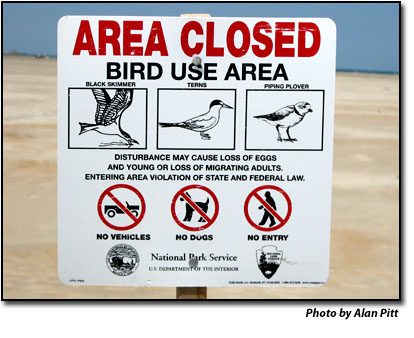
The Point was closed to off-road vehicles on March 18, the earliest date so far. The closure came after piping plovers were observed exhibiting breeding behavior in the area south of Ramp 44 and just north of the Point known as the “Narrows.”
However, pedestrians who were willing to wade in the water below the low-tide line for about a quarter mile were allowed to bypass the resource closure to reach Cape Point, which was still open.
And plenty of fishermen and visitors have been doing this – or at least trying to do this. The flounder and drum fishing has been exceptional at the Point in recent weeks.
The problem is that too many of the anglers and others have not been staying in the water to get to Cape Point but have been violating resource closures.
So the Park Service has closed down the Point – period.
Even if you wade past the closure, you will not be allowed to come ashore at Cape Point. You cannot set foot on the dry sand above the low-tide mark.
If you try and are caught by a Park Service ranger, you will probably be cited for a violation of the resource closure.
Cyndy Holda, Cape Hatteras National Seashore public relations specialist, said today that the closure is about a half mile long now, which she said was “too lengthy to safely walk in the water,” which can be rough with strong currents.
In addition, she said, there have been multiple violations of the resource closure by people who did not stay in the water.
Britta Muiznieks, the seashore’s wildlife biologist, confirmed that there had been a large number of violations of the closure between Ramp 44 and Cape Point.
She said biologists and park rangers have observed people in the closed areas, even flying kites. And numerous foot prints indicate people and dogs have walked through the resource closure.
Some of the foot prints, she said, have come as close as 15 to 30 meters to piping plover nests, and people, probably anglers, have been cutting through the resource closure to get to the good flounder fishing in the “hook” south and west of Cape Point.
The prescribed buffer for pedestrians and ORVs for piping plover nests and breeding activity is 50 meters.
Holda noted that, according to the terms of the consent decree that dictates management of the seashore until the park has a final, long-range access plan, Superintendent Mike Murray can exercise his discretion “to provide additional protections as needed.”
“If people aren’t paying attention to the signage,” Holda said, the park needs to institute the additional protections.
“This time of year, it’s a very fluid situation,” Holda added. The shorebirds, she said, are staking out territory and checking out nesting sites.
“We try to keep it (the beach) open as long as we can,” she said, “but if it’s so confusing to the public that we can’t sign it effectively, then we have to take other measures.”
Once the birds establish nests, there is a possibility that more public access can be allowed.
Muiznieks said that there are two piping plover nests at Cape Point – one of them just south of the Narrows — and a third nest south and west of the Point near Salt Pond Road. She said there is also a pair of oystercatchers exhibiting breeding behavior in the resource closure south of Ramp 44. That pair, she said, hasn’t decided yet where to nest.
“We just couldn’t control the public,” Muiznieks said, even though rangers and biologists tried to keep a close watch and speak with violators.
So, the rule for now is that you should not attempt to reach Cape Point, even on foot and even wading in the water.
Ramps 43 and 44 are still open to ORVs with some beach access. Ramp 45 is open to ORVs and pedestrians, but only for about two-tenths of a mile.
Subject
Name
(required, will not be published)
(required, will not be published)
City :
State :
Your Comments:
May be posted on the Letters to the Editor page at the discretion of the editor.
May be posted on the Letters to the Editor page at the discretion of the editor.
May be posted on the Letters to the Editor page at the discretion of the editor.
May be posted on the Letters to the Editor page at the discretion of the editor.