
Silent Spring: Where are all Ocracoke’s frogs and toads?
When Rachel Carson published her environmental classic, “Silent Spring,” in 1962, she was referring to the silence of songbirds, quoting a line from a John Keats’ poem that reads, “The sedge is withered from the lake and no birds sing.”
The silence Ocracokers have been noticing recently is not that of songbirds, but of the tree frogs and the Fowler’s toads, whose voices used to echo through the village from spring until fall. Chubby toads lounged in flower gardens and spry green and squirrel tree frogs clung to windows and slipped through open doorways. Children played with them, stuffing them into their pockets. Sometimes a little green frog would jump down someone’s shirt.
For the last year or two, however, they have been noticeably absent, and more and more people are wondering why.
Amphibians have always been scarce on Ocracoke. No salamanders are recorded living here, and only four members of the order known as Salientia (frogs and toads) have been identified on the island.
State herpetologist Alvin Braswell, who works at the North Carolina State Museum in Raleigh, identifies them as the Fowler’s toad (Bufo woodhousei), the green tree frog (Hyla cinerea), the squirrel tree frog (Hyla squirella), and, less commonly, the Southern leopard frog (Rana sphenocephala).
All have moist, sensitive skin which makes them extremely sensitive to changes in their environment.
Adult Fowler’s toads are 2 to 3 1/4 inches long and have brown, olive or gray dorsums, speckled with darker spots, warts, and a light stripe down the back. They breed, according to Braswell, in spring and early summer and live an average of five to seven years. The males emit a loud, discordant mating call that lasts one to four seconds and sounds like “wa-a-a-ah.” It takes about two months for the 7,000 or so eggs the females lay to transform to tadpoles and then to tiny toads. It takes three to four more years before they are of breeding age.
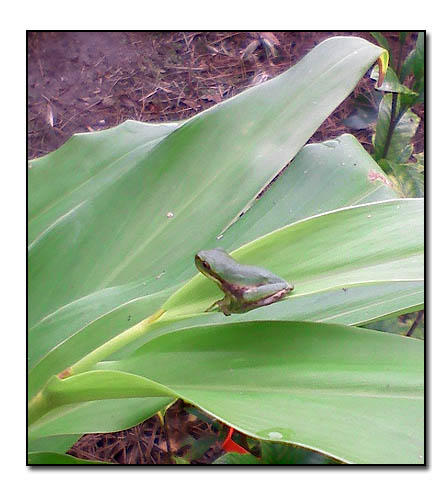
The green and squirrel tree frogs may live three to five years. They typically breed from April to July, but their mating calls may be heard into September. Green tree frogs have long legs and smooth skin and sometimes reach a length of 2 1/2 inches. Their call is a bell-like, nasal “queenk,” repeated once a second. Females lay about 400 eggs. Squirrel tree frogs are smaller, 1 to 1 1/2 inches. They can change skin tone from dull brown to green, with or without spots. It is the call of squirrel tree frogs which often resound after summer storms, sounding like a flat, nasal, duck-like “waaaak,” repeated every half second.
All three species depend on ephemeral fresh water sites that are hydrated every year to lay their eggs and hatch their tadpoles. Drought during their breeding seasons could cause them to die off.
While there are only a few species, individual tree frogs and toads have until recently been prolific. Lots of full and part-time residents have noticed the change.
U. S. National Park Service ranger Kenny Ballance remembers seeing only one at his cottage on Back Road, and two at the Pony Pens. Park bio-tech Jocelyn Wright has seen none in the two years she has worked here. Some of the men working on the Ocracoke Airport building, located within the park, do recall seeing some of the tree frogs this past summer and fall.
Many islanders say they blame mosquito spraying for the decrease in toads and frogs on Ocracoke. During the months of mosquito season, which can last from spring through fall, the hum of the mosquito truck is a familiar evening sound, and residents and guests rush to close their windows when they hear its approach.
Much of Rachel Carson’s book presents evidence that the pesticide DDT was responsible for the death of birds and other organisms during the 1950s and ‘60s, and she predicted that unless its use was curtailed, there would indeed be a silent spring.
Ocracoke resident Thomas Midgett remembers the days following World War II, during which DDT use was heavy on the island. Trucks drove around the village spraying the pesticide behind them. It felt good on hot summer days, and laughing children followed it, playing in the mist.
The toads and frogs disappeared, recalls Thomas, along with other wildlife. After DDT was banned the amphibians made a gradual come-back. But, says Midgett, who lives near Pamlico Sound and the salt marsh, “There used to be lots of those toads back where I am, and frogs as well. I saw a few of the little brown frogs last summer, but the toads and the green frogs are gone.
“You don’t see a lot of things you used to see here,” he adds, shaking his head. “A lot of the birds and what we used to call furry worms (probably what some people call wooly bears-caterpillars) are not here any more.”
Blanche Joliff, who has lived on the island most of her life, recalls the time years ago when the frogs and toads disappeared.
“It was DDT, they said. The DDT killed the toad-frogs.”
Now she sees very few of the green tree frogs and has not seen any Fowler’s toads near her home on Howard Street, and she misses them.
The pesticide now being sprayed at Ocracoke is not DDT, however, but a product called Master Line Kontrol 4-4. The active ingredients in this product, Permethrin and Piperonyl Butoxide, are claimed to be environmentally safe and are approved by the Environmental Protection Agency.
Barry Engber, medical entomologist for the North Carolina Department of Environment and Natural Resources, said that it is a commonly used mosquito pesticide believed to be harmless.
“Most people think that they (the sprayers) are trying to coat surfaces,” he said. “Not true. Droplets have to hit mosquitoes in flight. The droplets, which are much smaller than raindrops, have a very short half-life, and should lose their potency by the next morning.”
“What about the warning on the label?” I asked him, reading aloud the statement written under environmental hazards: “This pesticide is extremely toxic to aquatic organisms, including fish and aquatic invertebrates…”
Engber conceded that if used incorrectly the chemical could kill amphibians and that it might impact frog and toad populations by killing insects they depend on for food. He concluded that “I can’t say for sure, but I kind of doubt that it’s killing frogs.”
A toxicology report on Master Line Kontrol 4-4, which Braswell found on the Internet, stated that “Amphibians are much more tolerant of Permethrin than the fish and arthropods.” It added, however, that “It should be noted that ‘much more tolerant’ can mean they do not die in a short time frame.”
The report also said that “Permethrin disrupts the growth and development of tadpoles (and) affects brain function in tadpoles.”
Rudy Austin, president of Ocracoke’s Mosquito Control Committee, said that he does not think the pesticide would kill frogs or toads and said that because it was so dry, they hadn’t had to do a lot of spraying the last two years.
The committee has recently spent about $11,000, he added, on new improved equipment which fine-tunes the direction and speed of the spray, so that it does not enter waterways and is safer in general.
“We are trying to be as efficient and safe as we can be,” he said.
In discussing the disappearance of the frogs and toads, he noted that on Portsmouth Island, where no chemicals are sprayed, there are few or no frogs and toads.
If this is true, then what else might have caused the disappearance of most of Ocracoke’s hopping amphibians?
Braswell, the state herpetologist, mentioned several possibilities.
One is the drought that Rudy Austin had mentioned. Ocracoke, along with the rest of the state, experienced unusually dry spring and summer seasons in 2008 and 2009. If Ocracoke’s freshwater ponds and puddles dried up during breeding season, said Braswell, there would have been no offspring — what he called recruitment — to replenish the adult stock. The lack of rain could also have caused increased salinity, which the tadpoles might not be able to survive.
Increased overall pollution, brought about by more people living on and visiting the island, is what part-year resident Serge Gracovetsky thinks may be wrong. Braswell confirmed that it could certainly contribute. Motor oil, either dumped or accidentally leaked into waterways, is deadly to aquatic life. Fertilizers, pesticides, sewage — all products of a growing human presence, combined with fewer undeveloped areas for breeding and spawning, make Ocracoke a less hospitable habitat for frogs and toads.
Could the burgeoning feral cat population have an effect on the amphibians? It could. Both dogs and cats sometimes kill the amphibians, along with natural predators, such as eastern hognose and ribbon snakes and black racers. There are also a lot more ducks and minks here than before, noted Rudy Austin, and now raccoons live on the island — all of which may contribute to the decline.
A more ominous possibility is the introduction of Chytrid fungus or Ranavirus, two diseases which have been ravaging frog and toad populations worldwide. It is not known for sure where they originated, says Braswell, but both have now been detected in North Carolina.
Chytrid fungus has already led to the extinction of several species. It is the worldwide food and pet markets that led to the introduction of these exotic diseases. Frog legs and aquarium frog pets have become big business and are transported all over the world by airlines and shipping lines. According to an article published in “New Scientist” by Catherine Brahie, “Global trade is spreading two severe diseases, one of which is blamed for driving amphibians towards extinction.”
Some scientists blame the global loss of amphibians on an increase of ultraviolet rays entering earth’s atmosphere through a “hole” in the ozone layer caused by manmade CFCs (hydroflourocarbons). Because of their sensitive, highly absorbent skins, frogs, toads, and salamanders are exceptionally vulnerable to the rays.
The same phenomenon does not seem to be affecting the northern Outer Banks. Retired National Park Service biologist Marcia Lyons and North Carolina Coastal Federation coastkeeper Jan DeBlieu said that last summer they saw or heard lots of tree frogs. Dare County does spray for mosquitoes, Lyons added. She was not sure about whether Fowler’s toads were abundant.
According to Jeff Hall, writing for the N.C. Wildlife Resources Commission’s magazine, “Wildlife in North Carolina,” coastal plain amphibian diversity is “in trouble…” The species most at risk are not found at Ocracoke, but the decrease in frogs and toads could be related to what is happening on the mainland.
If it was the drought conditions of the past two years that reduced their populations, Braswell said that they may rebound soon. Because of all the winter rain, he expects this year to be a good breeding season for amphibians. It will probably take several years, however, before the improvement will be noticeable — the time it takes for this year’s tadpoles to reach breeding age.
If the decline in Ocracoke’s frogs and toads should turn out to be caused by mosquito spraying, what other options are available?
Engber mentioned larval control with a product called methaprene, which is put into the water to regulate mosquito growth.
“There was an issue for a while where it was blamed for frog deformities,” he said, “but that doesn’t seem to be the case.”
There is also a product – BTI — which uses bacteria that are very specific to mosquitoes. It is being used in parts of North Carolina. Proper drainage of standing water is also a way to control mosquitoes. The ditches that crisscross Ocracoke village were created for the purpose of mitigating mosquitoes.
It well may be that the decline in frogs and toads is due to a combination of all of these causes. The good news is that all of the species are common in other parts of the state and could be re-introduced, if necessary.
Blanche Joliff told me a charming tale of how, after the toad-frogs were killed off by DDT, Mrs. Eleanor Burrus went to Hatteras, where toads still lived, and filled up a shoe box with them. She brought them back to Ocracoke, and they have lived here ever since.
Until now, that is. If they do not replenish themselves naturally, someone could indeed bring back a shoe box full of toads and frogs, thus ending Ocracoke’s silent spring.