
UPDATE… Serendipity is returning to movie-star status ….WITH SLIDE SHOW
The vintage-style “Blue Room” wallpaper began going up this week in the Hatteras Island beach house made famous by the romance movie “Nights in Rodanthe.”
Serendipity was saved from probable demise at the edge of the Atlantic Ocean by its new owners Ben and Debbie Huss of Newton, N.C. The couple is in Rodanthe this week, scrupulously attending to details to recreate the film-version of the celebrated house, inside and out, and they have a tight production schedule to meet. Its opening act – the first vacation rental of the season – is set for the week of May 5.
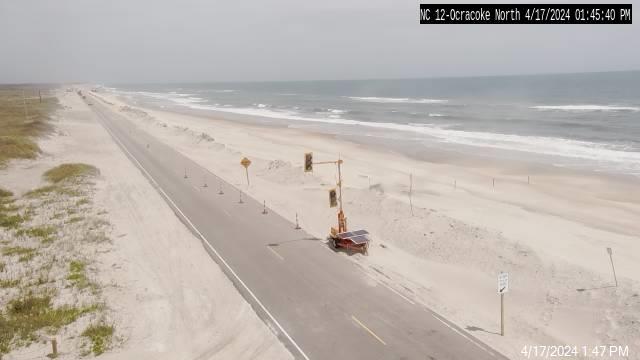
Since it was built in 1988, Serendipity was the first house to come into view after crossing Oregon Inlet, onto Hatteras Island and driving through the Pea Island National Wildlife Refuge. However, with no dune to protect it from the Atlantic Ocean during major and minor storms, the house had become a “problem child” for locals and visitors alike. Sand and saltwater frequently were wind-driven under and around the house in the Mirlo Beach development and onto the only route on and off the island – Highway 12 – forcing delays and road closures, and the house itself had been condemned multiple times as a result of storm damage.
The Husses negotiated to buy the house to save it from likely demolition during much of last year and closed on the deal right after the first of the new year. In January, in between storms that still sent sea water surging under and around the house, they had Serendipity moved amid a parade of onlookers to a more protected site on East Beacon Road, about one-half mile south of its original location.
The effort is a labor of love for the Husses, who saw the house in the 2008 film starring Richard Gere and Diane Lane, and then during subsequent trips to Hatteras Island. When they learned of its plight, the couple decided Serendipity “needed them.”
“We just had to save it,” Ben Huss explains. “We weren’t going to let it fall into the ocean. It’s not an antique house or a historical house, but it’s an iconic house, and we just couldn’t let it die.”
According to Huss, preserving Serendipity is a financial gamble for him and his wife, “but I’m an old, hard-headed, crazy risk-taker,” he says with a laugh and a smile. “We want to bring Serendipity back to its movie-style glory so people can enjoy it.”
Work has been ongoing to the building’s exterior to recreate the look of the enchanting “Inn at Rodanthe,” as it was fashioned by moviemakers.
Only the film’s exteriors were shot at Serendipity and around Rodanthe, and once shooting was complete at the house, all of the exterior enhancements made to the house for “Nights in Rodanthe” were removed.
Now, the inside is getting a Hollywood-style makeover as well to match the set that was used for interior shots in the movie, which were filmed in and around Wilmington.
With at least six weekly rentals already contracted through Vacation Traditions, the Husses are working feverishly get the house to ready for its debut. To that end, the couple’s project manager, Mike Price, had photos of the film-version of house film blown up, and they’re matching its details down to the blue storm shutters, wallpapers, paint colors, swinging kitchen doors, hanging beads, and furnishings.
Tools and equipment are scattered everywhere both on the inside and outside of Serendipity, and the Husses are hard at work with their crews. Debbie Huss and her interior decorator Rebecca Ennis searched through countless sample books to find exact matches for the wallpapers seen in the film.
“We’re hanging paper in the (Richard Gere) ‘Blue Room’ now,” Debbie Huss says, “and we’ve got the Diane Lane bedroom floral wallpaper up. We want to decorate four or five of the rooms in the house to look just like they were in the movie, right down to the paint colors we use.”
It is all in the details. The swinging door with carved, metal inserts has been handmade for the kitchen entrance to match the movie set. A family friend is donating a 1918 pump organ for the dining room area.
“I have to figure out which wall to put it against,” Debbie Huss says. “It’s a dilemma, but it has to go in here because there’s one in the movie.”
Mike Price and his crew are engineering new stairs, decks, and roof trusses piece-by-piece.
“Mike is my fabricator,” Ben Huss explains. “It’s hard to get all of the angles on these roofs right. A lot of it is figuring the pitch. It’s complicated, because we don’t have any blueprints to work from.”
“I’ve done a lot of different stuff you know,” Price adds while stroking his full beard, then pushing his ball cap back a bit, “but this one is pretty interesting.” Price, who is from Concord, N.C., has been a contractor for 37 years and says Serendipity is one of the most challenging jobs he’s ever had.
“There aren’t any plans… you know, it’s Hollywood. So we work for awhile, then I run inside and look at the pictures again just to make sure we’re doing it right.”
Ben Huss refers to the entire process as “paint by numbers.”
It’s a literal statement for some elements. Hatteras Island resident Beth Bird, who worked on the house during its prep for the film, offered the Huss’s a gallon of left-over paint that was used on the blue exterior shutters. Having that paint has allowed the contractors to match the color exactly for the new shutters that will soon be going up on the windows.
Although Serendipity is going though many changes and additions, some of its original elements are being carefully preserved. The wood paneling in the house is made from Brazilian cedar, shipped to the island by the original owners of the house, Roger and Celia Meekins. It can be best appreciated in the cathedral ceiling of the octagonal tower on the north side of the house.
“Just look at that ceiling,” Ben Huss says. “You can see why we had to save this house… The interior has sustained very little damage because of the way it was built. I thought this paneling was just plain old bead-board, and we thought about painting it, but then I learned its history. It’s really nice wood.”
The couple has been receiving inquiries from a wide variety of people eager to rent the house for special events, and with special requests. Ben Huss points out the ocean-side deck and the set of steps that lead down to the beach.
“See all of these pickets? Folks want these pickets to be painted white, just like in the movie,” he says. “There’s this super-romantic fellow who’s been calling me, wanting to reserve the place for his wedding in October. He wants to know if there’s somewhere he can rent some ponies, so when his pretty new bride walks down these 19 steps in her flowing white gown, someone can release the ponies to run down the beach. I told him that was a pretty special wedding he was planning, and asked him how long he and his girl have been together. He says 16 years. I laughed, and said ‘Well, I guess that’s why.’
“Another fellow from Ocean City has about a dozen clothing stores. He wants to rent the house for a photo shoot with surfer-models to promote his new clothing line,” Ben Huss says.
The Husses hope to rent the house as often as possible and are offering it to charity groups for a reduced rate. They plan to use it themselves only in the off-season or when it’s not booked. Ultimately, whether Serendipity reimburses the couple for the financial gamble they’ve taken is a matter of faith.
“I do a lot of praying,” Ben Huss says, “and just say ‘PUSH’. Do you know what that means? It means ‘pray until something happens.’ And that’s what we do.”
Roger Meekins, in his own words, on the story of the Spanish cedar
Just before the construction of Serendipity-at-Mirlo commenced in 1987, I had recently completed an inter-disciplinary master’s degree at NCSU in Wood Technology and International Development. I was at the time also doing some volunteer technical advisory work at several overseas locations on projects with the International Executive Service Corps (IESC). As a result of this various exposure, I had learned about a fairly exotic species of wood known as Spanish Cedar (cedro, in its scientific, generic terminology), which is specifically noted for its accentuated freshness and cedar-related aroma. I decided to incorporate this as a recognizable element into the construction of what was to be the one of the first of a kind, “world-class” beach house on Hatteras Island.
Cedro grows in the Amazon River basin in Brazil and at some other locations in Central America. This particular wood used in the interior of Serendipity’s construction grew about 2,000 miles upriver along the Amazon. The logs were cut and floated about 1,000 miles downriver to a sawmill. There, it was sawn into rough lumber, loaded on a barge and barged another 1,000 miles to the port of Belem, on the Atlantic Ocean, where it was then ocean-freighted to a lumber company in New Orleans. I purchased the rough lumber from them, and from there it was trucked to the Outer Banks. I next employed the J. W. Jones Lumber Co. of Elizabeth City to mill the rough lumber into tongue-and-groove beaded paneling for installation on the walls of the common areas in the house. Other elements, such as the staircase handrails and balcony railing and posts of Spanish cedar, were milled-out and assembled in my own shop in Manteo.
But here is perhaps a little-known fact about this exotic wood and important for any new owners to know, so that they may take advantage of a bonus which probably they didn’t even know they had acquired, and likely may never have come to their attention otherwise. After several years of regular atmospheric exposure, the accentuated aroma of the cedar fades. However, the new owners, in their rehabilitation efforts and processes can easily restore it to the original smell by simply sanding down the exposed surfaces of the untreated, raw wood. The aroma of cedar comes from what is known as an “extractive” in the growth processes of the tree, and this can be renewed periodically simply by exposing a new surface of the wood (a simple light sanding with a very fine-grain sandpaper, using an orbital, rotary, or belt sander will do the trick).
So herein is my continuing contribution to helping prolong the life of a house which has attracted so much attention over so many years, and has become famous enough to interest someone like the Huss family to do something about nostalgically preserving its life and its legendary recognition. Just a little sandpaper can restore the exotic cedro aroma of the house, and again it will exhibit its original freshness of a South American jungle.
CLICK HERE TO VIEW SLIDE SHOW
Other Serendipity Articles:
http://www.islandfreepress.org/2010Archives/01.13.2010-SerendipityMayBeOnTheMoveOnFriday.html
http://www.islandfreepress.org/2010Archives/01.06.2010-TheDealIsSealedAndSerendipityWillBeOnTheMove.html
http://www.islandfreepress.org/2009Archives/12.18.2009-SerendipityHasASuitorWhoProposesToMoveItAndRestoreIt.html
http://www.islandfreepress.org/2009Archives/12.18.2009-SerendipityHasASuitorWhoProposesToMoveItAndRestoreIt.html
Subject
Name
(required, will not be published)
(required, will not be published)
City :
State :
Your Comments:
May be posted on the Letters to the Editor page at the discretion of the editor.
May be posted on the Letters to the Editor page at the discretion of the editor.
May be posted on the Letters to the Editor page at the discretion of the editor.
May be posted on the Letters to the Editor page at the discretion of the editor.